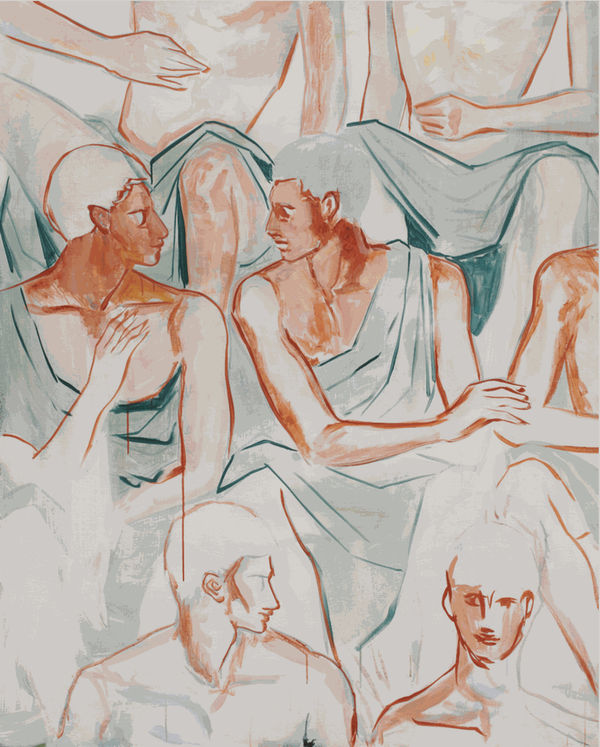
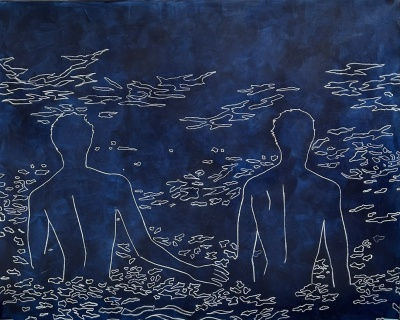
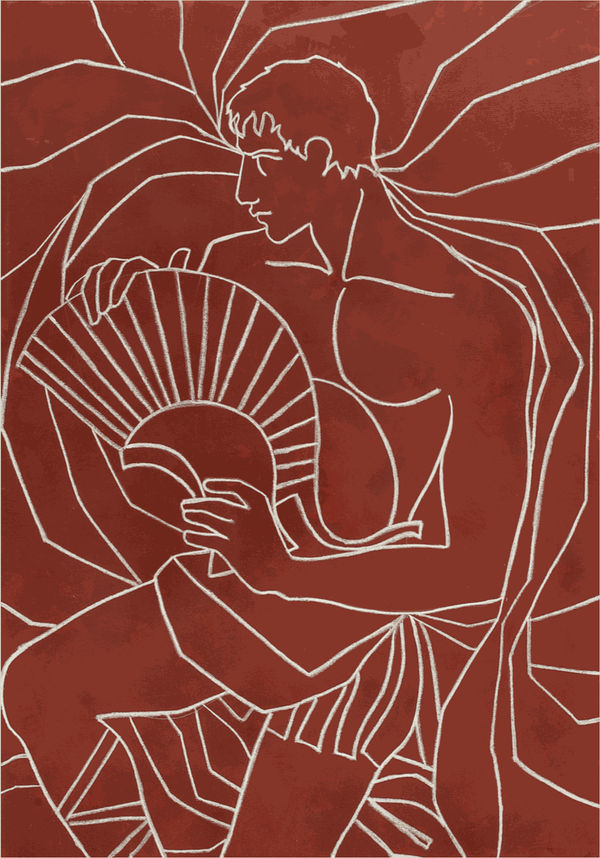
"My main source of inspiration is classical antiquity, but I am also fascinated by the primordial relationship between humanity and art, which originated on the walls of caves."

Born in Lugano to a Swiss mother and an Italian father, Roberto Ruspoli grew up in Rome. At the age of eighteen, he left Italy to study at the School of Visual Arts in New York. From an early age, Ruspoli was fascinated by drawing and painting: “For as long as I can remember, I’ve always drawn. When I cried as a child, my mother would give me paper and pencils to draw — it was the only thing that calmed me.” In New York, he began exhibiting his work for the first time, meeting some of the most influential figures of the city’s 1990s art scene. He particularly cites the influence of his teacher, Michael Goldberg, one of the leading American abstract expressionists alongside Jackson Pollock and Willem de Kooning.

After five years in New York, Ruspoli returned to Europe, first to London, then to Paris, where he decided to settle permanently. His first solo exhibition in a Saint-Germain-des-Prés gallery was a success: “My artistic language is very French; culturally I feel very close to France,” he explains.

Among his influences, he mentions choreographer Pina Bausch: “In 1999, I performed in O Dido in Rome, which had a profound impact on me. There is a real connection between dance and drawing. When you draw, you create a continuous, uninterrupted line over a large surface, much like a dancer interacts with the space around them. For me, it’s almost meditative, you have to stop thinking and learn to let go, otherwise you lose the magic. I love spontaneity.” Ruspoli is also inspired by Cocteau, as well as Picasso and Rothko, for their use of color and abstraction.

His aesthetic, featuring figures drawn in profile, is undoubtedly influenced by his childhood in Rome and his classical education.
The mural format, widely used in Pompeii and Herculaneum, demands a certain boldness to paint directly onto walls. “I love living surrounded by paintings. When you work directly on walls,” says Ruspoli, “there’s no room for mistakes. This kind of painting gives me an adrenaline rush, it’s a completely different sensation.”

It is in his studio, in the heart of Paris’s 14th arrondissement, that Ruspoli prepares his projects, where he has recently started painting on canvas and experimenting with more complex pigments.

In 2018, interior designer Fabrizio Casiraghi commissioned Ruspoli for his first public project: Bibliothèque bohème for AD Intérieurs, for which Ruspoli created a monumental fresco covering the entire ceiling. Since then, Casiraghi has continued to collaborate with him on several residential projects and, more recently, on the murals for the newly redesigned Parisian restaurant Drouant. “I really enjoyed working in such a prestigious space. My inspiration came from Marcel Proust’s In the Shadow of Young Girls in Flower. I chose to work in blue, with the idea of combining lines and marks.”

Roberto Ruspoli is a unique artist whose work interweaves dance, history, and abstract expression, marked by a deep connection to French culture and influences ranging from Pina Bausch to Picasso. His art, oscillating between drawing and mural painting, reveals a constant search for spontaneity and meditation within the creative process, establishing him as a prominent figure on the contemporary art scene.